
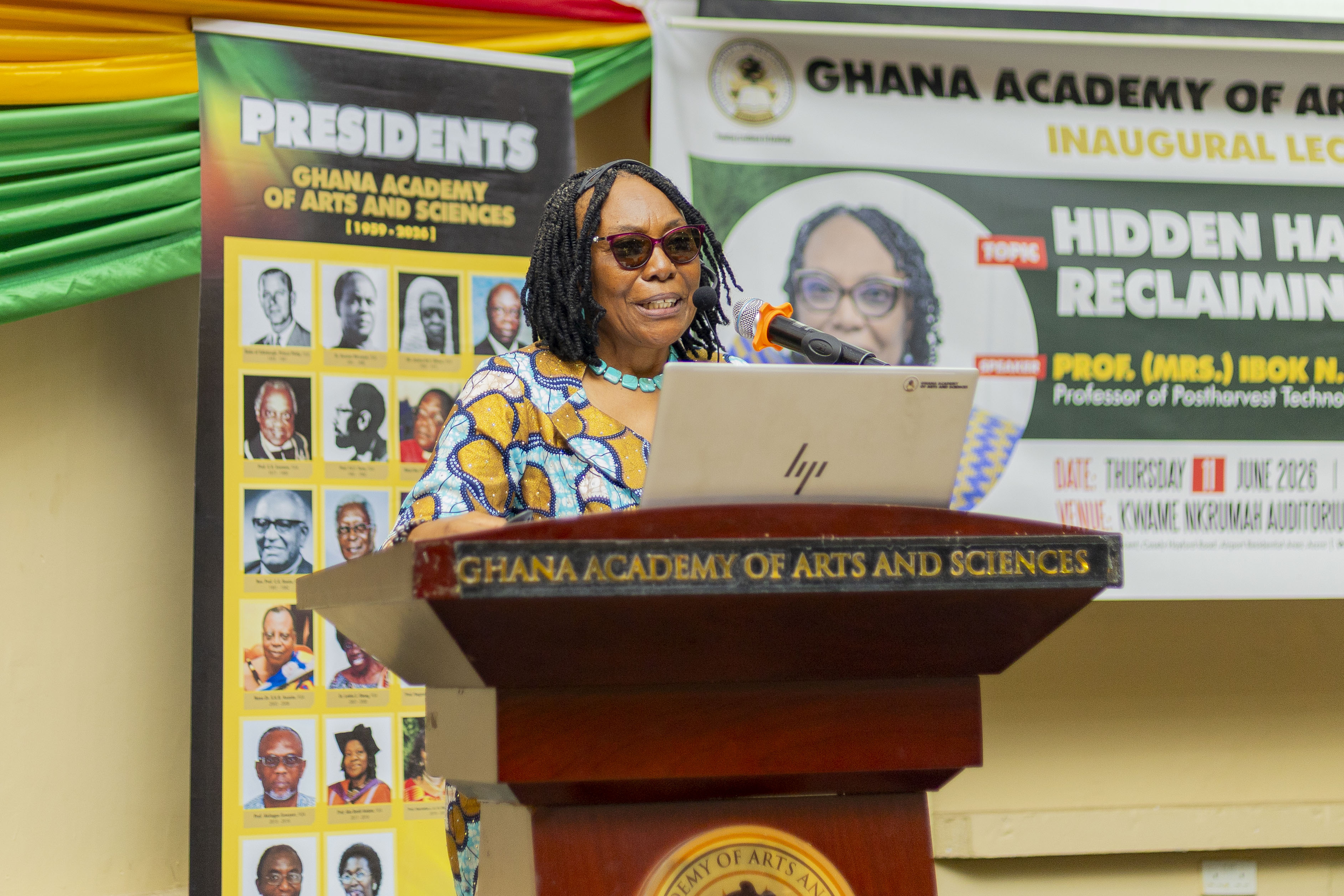
Professor Ibok Oduro, a renowned food scientist at the Kwame Nkrumah University of Science and Technology, Kumasi (KNUST) and Fellow of the Ghana Academy of Arts and Sciences (GAAS), has called on Africans to rediscover and invest in indigenous crops, describing products such as sweet potato gari as "hidden treasures" capable of addressing the continent's food security, nutrition and economic challenges.
Delivering the fourth inaugural lecture of the Ghana Academy of Arts and Sciences (GAAS) for 2026 on the theme, "Hidden Harvests: Reclaiming Africa's Plate," Prof. Oduro argued that Africa's food future lies not in imported foods but in the indigenous crops and traditional knowledge systems that have sustained communities for generations.
"Across the continent, we are not lacking food resources. What we are often lacking is recognition, investment and confidence in what we already have," she said.
Using the biblical parable of the talents, Prof. Oduro likened Africa's treatment of indigenous crops to the servant who buried his talent instead of investing it.
"We have been entrusted with a diversity of indigenous crops. Many of these are nutrient-rich, climate-resilient and deeply embedded in our cultures, and yet many of these resources remain hidden," she said.
At the centre of her lecture was the story of sweet potato gari, a product she described as one of Africa's hidden treasures.
Prof. Oduro recounted how she and her colleagues sought to determine whether sweet potatoes could be processed into gari, an idea that was initially met with scepticism.
"When we explained what we wanted to do, they laughed. Some openly questioned whether sweet potato could ever be turned into gari," she recalled.
Despite the doubts, the researchers proceeded with the experiment. The resulting product was sweeter, crispier and well received by consumers. What began as an idea dismissed by many later earned international recognition, including a Best Paper Award at a symposium in Japan.
The success of sweet potato gari, she said, demonstrates how overlooked crops can be transformed into valuable products through research and innovation.
Prof. Oduro expressed concern over Africa's growing dependence on imported foods despite its vast agricultural resources. According to her, Africa spent approximately US$97 billion on food imports between 2021 and 2023, representing a 19% increase compared with a decade earlier.
"This expenditure represents a massive outflow of foreign exchange reserves that could have been invested in domestic infrastructure and healthcare," she said.
She warned that increasing reliance on imported foods is shifting diets away from nutrient-dense traditional foods towards refined carbohydrates, sugars and fats, contributing to rising rates of obesity and diabetes across the continent.
Beyond sweet potato gari, Prof. Oduro highlighted several underutilised indigenous crops and food resources with significant potential, including yam bean, water yam, aerial yam (air potato), frafra potato, breadfruit, African mango, soursop, sweetsop and overripe plantain.
She said yam bean flour could serve as an alternative to imported wheat flour, while some water yam varieties possess high dietary fibre content that can support digestive health. Aerial yam, often dismissed as a weed because of its rapid growth, has shown promising functional properties for food processing, while frafra potato possesses starch qualities suitable for industrial applications.
Prof. Oduro also showcased innovations developed from indigenous crops, including sweet potato leaf tea, sweet potato leaf powder, crackers fortified with moringa and sweet potato leaves, and infant foods produced from breadfruit and local grains.
While highlighting decades of research into indigenous crops, she stressed that scientific discoveries alone cannot transform food systems.
"Research in isolation does not change lives. It is only when research moves beyond the laboratory, into markets, into homes and into industry, that it becomes truly meaningful," she said.
She pointed to training programmes, food festivals and collaborations with farmers, entrepreneurs and industry players as practical ways of translating research into livelihoods and businesses.
Prof. Oduro outlined several measures needed to reclaim Africa's food heritage, including investing in indigenous crop research, reducing post-harvest losses, strengthening policy support, promoting local food consumption through education and empowering young entrepreneurs to innovate around local crops.
"If we are to reclaim Africa's plate, we must invest in indigenous food research and value addition, strengthen policy support, promote local food consumption, empower youth entrepreneurs and build partnerships across academia, industry, government and communities," she said.
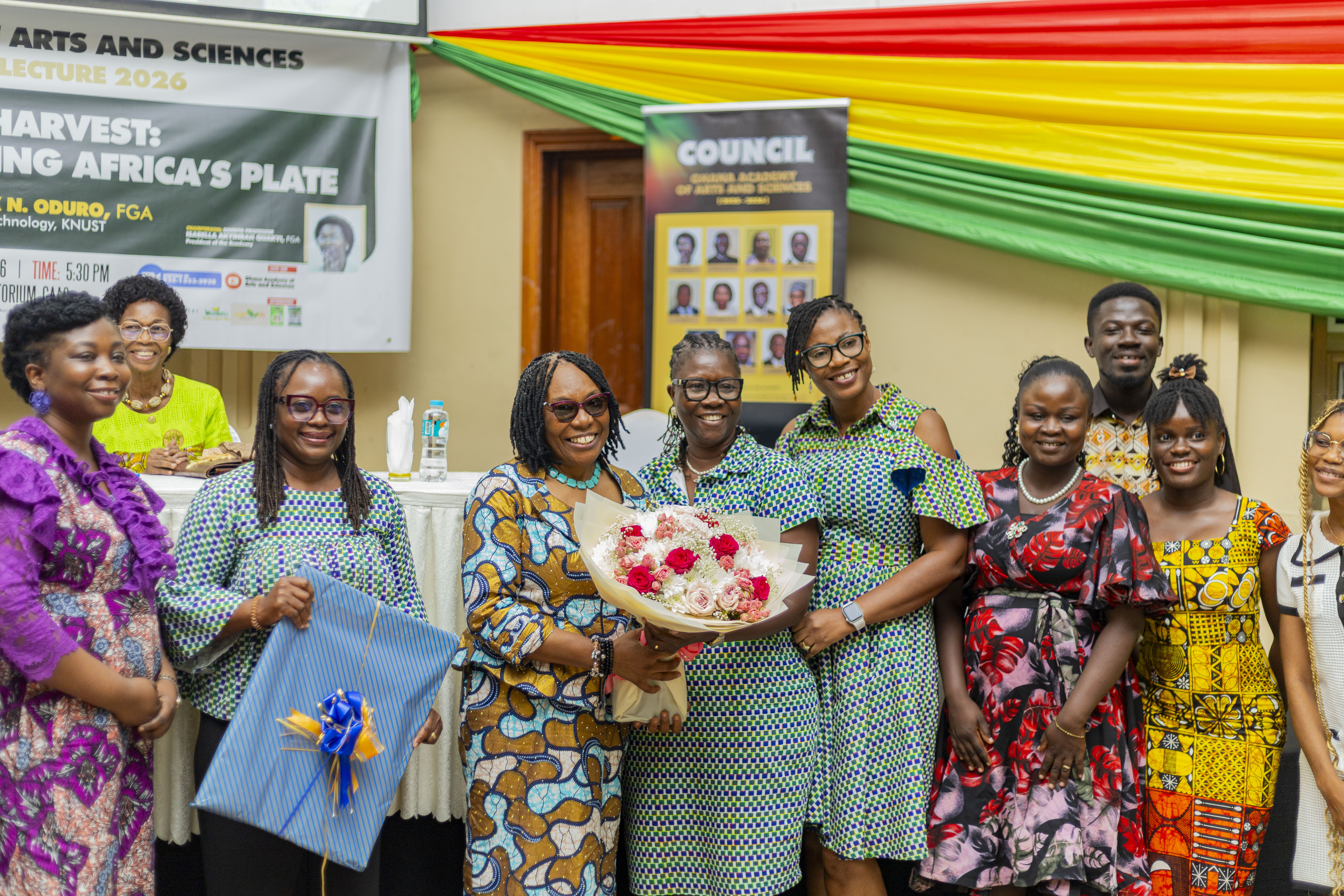
She concluded with a reminder of the continent's untapped potential.
"We have the crops. We have the knowledge. We have the people. What remains is the will to recognise and invest."

According to her, Africa's food future should not be imported but cultivated from within.
"Our harvest is not absent. It is simply hidden."
Chairing the lecture, President of the Ghana Academy of Arts and Sciences, Professor Emerita Isabella Akyinbah Quakyi, described the event as an opportunity to reflect on food and nutrition security while exploring the opportunities embedded in Africa's agricultural heritage.
Prof. Quakyi commended Prof. Oduro's contributions to post-harvest technology and food systems transformation, noting that her work demonstrates how science, innovation and entrepreneurship can unlock value from indigenous crops.


